DMLS vs DMLS
Hubert Chathi
@hubert:uhoreg.ca
FOSDEM 2026 — February 1, 2026
Hi
- I'm Hubert Chathi (a.k.a. uhoreg)
- Crypto team an Element
- Matrix Spec Core Team
- investigated decentralizing MLS for Matrix
- wrote a partial, experimental MLS implementation in TypeScript
What is Messaging Layer Security (MLS)?
- IETF standard (RFC9420) for end-to-end encryption in instant messaging
- can be applied to many different systems
- encrypts messages
- handshake messages can be encrypted or cleartext (though the sensitive parts are encrypted)
- ensures consistent group state (e.g. membership, "group context")
- provides Forward Secrecy and Post-Compromise Security
- does not provide Deniability
- updates only require O(log(n)) average(?)-case work (though inviting still requires O(n) work)
How does MLS work?
- focus on just one small part
- MLS group goes through different "epochs"
- each epoch has an "epoch secret"
- other secrets (e.g. encryption keys) are derived from it
- derived from previous epoch secret and commit secret (which comes from the commit message that created the epoch)
- old epoch secrets are thrown away
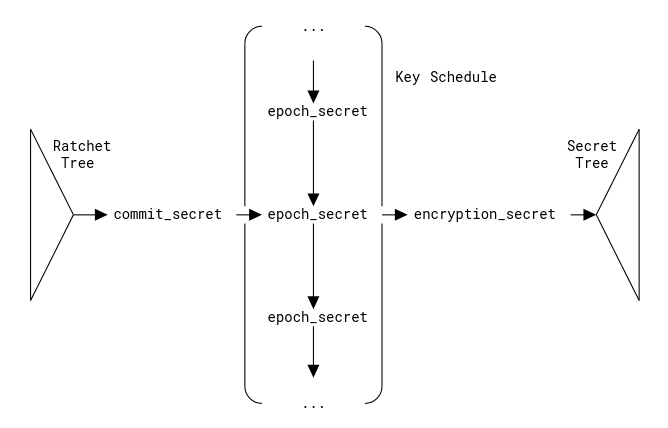
- commit messages are ordered: only one commit applies to each epoch, and any others are discarded
- Delivery Service responsible enforcing order
- what if we don't have a Delivery Service to order them?
Two approaches, as IETF drafts
- Decentralized MLS (a.k.a. DMLS)
(https://datatracker.ietf.org/doc/draft-kohbrok-mls-dmls/)
- written by Phoenix R&D, based on work by Amazon (formerly Wickr)
- Distributed MLS (a.k.a. DMLS) (https://datatracker.ietf.org/doc/draft-xue-distributed-mls/)
- by Germ Network and researchers from US Naval Postgraduate School
Decentralized MLS
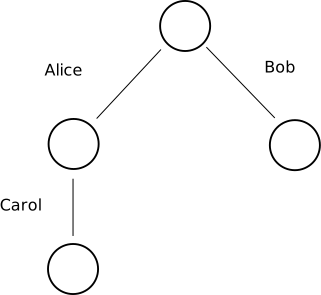
- allows epochs to have multiple descendants
- instead of linear order of epochs, we get a tree
- multiple senders can send commits that modify the same epoch
- uses Puncturable Pseudo-random Functions so that you can't re-derive an epoch secret – preserves forward secrecy
Questions
- how do you manage the forks?
- how do you determine membership and other shared group state?
My work (decentralised MLS)
- describes a way to decide which epoch to use, copy updates from one epoch to another
- assumes some sort of algorithm to determine membership/group state
Downsides to Decentralized MLS
- potentially requires a lot of storage (not clear when we can delete epochs, or if they need to be retained indefinitely)
- managing forks can be complicated
Distributed MLS
- each sender maintains their own MLS group ("sender group")
- updates their own group, but can pull in information from other groups
- group membership determined by each sender, but pulls in updates from other senders' trees
Downsides
- lose log(n) performance
- lose shared group context
- lose shared membership (but recipients can still see sender group's membership)
Comparisons
Which one is more "MLS-like"?
- both, but for different reasons
- Decentralized MLS: tries to keep MLS semantics, but requires more modifications to protocol
- Distributed MLS: fewer changes to the MLS group operations, but loses semantics (e.g. shared group contetxt)
Which one is faster?
- Decentralized MLS by itself can be O(log(n))
- managing forks can be expensive, depends on how many forks
- Distributed MLS is O(n) per operation
What are the storage requirements?
- Decentralized MLS: potentially unbounded, but depends on whether you can prune old forks, possibly close to O(n)
- Distributed MLS: O(n2) naively, or O(n)? if you don't keep unnecessary information
Which one to use?
- distributed MLS is more ready-to-use, decentralized MLS has more details to work out
- different tradeoffs
- depends on the underlying messaging protocol
- Matrix (servers are usually available and in contact with each other) - decentralized MLS?
- P2P (Ring, ToX, Briar) - distributed MLS?
- XMPP
- MUC - plain MLS
- 1-1
- plain MLS (designate one server as Delivery Service)
- distributed MLS?
Other approaches
- centralize handshake messages, decentralized application messages
- if SPOF fails, group members can send messages, but can't make any group changes, so we lose Post-Compromise Security
- determine a server to be Delivery Service and pick a new one if the current
one disappears
- a lot of literature on leader elections
- only feasible if "most" candidates are online (so, may not work for e.g. for P2P)
- DCGKA (Weidner et al), BeeKEM (Ink & Switch), or just keep using Signal protocol and variants (Olm/Megolm, OMEMO, etc.)